


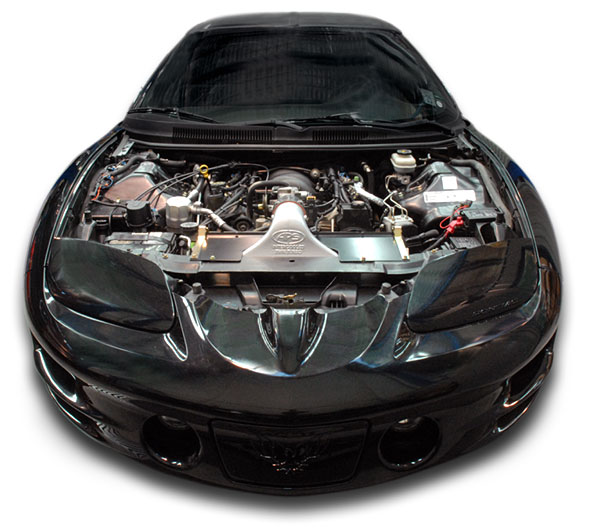
TURBO POWER
TURBO POWER. THE BEST WAY TO IMPROVE YOUR CARS PERFORMANCE, IS TO ADD ONE OR MORE TURBOCHARGERS.
WE ENGINEER IN THE IMPROVEMENTS THAT YOU WANT. ANY VEHICLE THAT WE SELL, CAN BE MODIFIED TO A RANGE OF OPTIONS, IN HORSEPOWER AND ENGINE TORQUE. TORQUE IS THE FORCE THAT MAKES THE WHEELS GO ROUND AND ROUND. RPM IS HOW MANY TURNS, THE COMBINATION IS CALLED HORSEPOWER. HORSEPOWER=TORQUE X RPM
Turbochargers, are very efficient at pumping air. Air plus fuel equals horsepower. An exhuast driven turbocharger uses the waste heat and pressure of the exhaust gases coming out of your exhaust manifold, and uses that wasted power to drive an air pump. The output of the air pump is used to feed higher pressure and therefore more air into the engine. When you increase the total fuel delivery by the fuel injection system, and add the correct air to fuel ratio, you will increase the entire combustion fuel efficiency, and horsepower delivered to the drive wheels.
The more air (oxygen) and fuel (gasoline or diesel) that you pump through your engine, the more potential horsepower and torque you will have at any given RPM. Standard sea level atmospheric pressure is 14.7 psi. Due to air intake restriction, the net air pressure feeding your engine is probably more like 13 psi. By adding the proper sized turbo exhaust driven charger, you can easily pump up the net air pressure to 30 psi and more than double the horsepower. There are other modification, to the fuel delivery fuel pressure, exhaust backpressure, and intake air temperature, and fuel timing that affect horsepower and torque a great deal. The fuel mileage at normal cruising highway speeds, may actually be better with a well designed and tuned turbocharging system, since energy is recovered from the exhaust that would have been lost, and in addition, the air into the engine is cooled, by a heat reducing exchanger, making the fuel more efficient. The fuel and air mixture, is swirled into the combusion chamber, and the vortex improves fuel and air mixtures.
Save fuel, get more MPG and get much more useable horspower for operation at high altitudes, and while climbing hills and when pulling loads behind the vehicle.
CCARS of Crosslake Cars , MN has the expertise to improve the performance and fuel efficiency of the cars that we offer. We specialize in adding a range of performance enhancements to the cars that we sell. We do the work to find those special automobiles, that will stand the test of time, and increase in desirability and value over time . The phrase, THEY DON'T MAKE EM LIKE THAT ANYMORE,.... takes on a new meaning. Contact our sales and engineering representatives and discover what we can do for you.
CORVETTE SUPERCHARGER KITS
SUPERCHARGERS BOLT ON BELT DRIVEN PROVIDE GOBS OF INCREASED HORSEPOWER AND TORQUE.
ProCharger now has 100% complete HO Intercooled Supercharger Systems available for 2009 model year LS7 ZO6 Corvettes. This new system is capable of producing 700+ crankshaft horsepower on stock motors running pump gas. The HO Intercooled System includes the industry standard P-1SC-1 ProCharger with patented and proven self-contained oiling, billet impeller and transmission case, a highly effective air-to-air intercooler system, and OEM quality brackets, hoses/tubing connectors and all necessary installation hardware. The ProCharger supercharger and brackets are provided with polished finish standard.
For those with modified applications, a ProCharger HO Tuner Kit for 2006-2009 GM LS7 Z06 Corvettes is also available. The Tuner Kit is complete with the exception of fuel injectors and tuning.
In addition to the largest power gains and coolest charge air temperatures, this bolt-on ProCharger kit also features the quickest and least costly installation of any forced induction system.
-
622 RWHP, 6 psi, ProCharger P-1SC-1*, stock LS7
-
587 RWHP, 4.5 psi, ProCharger P-1SC-1, stock LS7
-
820 RWHP, 14.5 psi, ProCharger F-1C*, modified LS7
NOTE: Higher boost levels represent Tuner Kits only and are available with P-1SC-1 and an Tuner Kit upgrade to a D-1SC ProCharger. The F-1C is a custom application for the LS7 Z06, for modified motors only.
2013 Chevrolet Corvette ZR1 Supercharged
The ZR1 is the quickest, most powerful and most expensive Corvette model ever made. It boasts 638 tire-shredding horsepower, the same Brembo carbon ceramic brakes used by the Bugatti Veyron and a sophisticated suspension system employed by a number of Ferrari models.
A 6.2-liter "LS9" V8 motor produces 638 horsepower at 6500 rpm and 604 pound-feet of torque at 4000 rpm, thanks in part to a four-lobe Eaton supercharger. Hand-built in Wixom, Michigan, the big V8 teams up with a close-ratio six-speed manual gearbox with a new high-capacity clutch designed for the increased power. The twin-disc 260mm design provides plenty of clamping power, while maintaining a relatively easy clutch action.
Hot Tuners
Is this the leading edge of the great Aussie tuning tradition, or just a bunch of mavericks? Whatever, meet the Aussie 200kW Club.
The 200 kilowatt club is an extreme form of expression. Normally, it's open only to those with serious wealth, those who can afford more than $100,000 (and sometimes double and triple that) for the best German, Italian or British machinery which has had teams of well paid boffins soiling their gloves in extracting the last skerrick of horse power from engines most of us will never sample.
There are guys out there who believe this is not right. Who reckon horse power should be available to all, or at least to those who know where to look. They're the hot tuners, the guys who take other people's product and turn it into what they see fit. Some, like CSV's Peter Dichiera, attach their own badge and compliance plate to the finished car. Others, like Peter Luxon, are content to deliver the right goods as a package on top of the manufacturer's own go-fast philosophy.
What they have in common is a desire to build fast cars and get them out the door at the right price. The three cars you see here are a case in point. The Corsa Strada Extreme you know about: it's CSV's interpretation of a VT Commodore, except with a 5.7 litre V8, some 245kW and a wicked body. If you read Pettendy's yarn a couple of months ago, the SVO Falcon is no stranger either, in racing parlance by Ford's official (American) hot shop out of Queensland's Southside Ford.
The APS WRX has also featured in these pages before, but this one's different. Instead of a power boost to 206kW, this particular example has a stage two kit which, says Luxon, provides no less than 235kW.
Are all three affordable? Compared with an M3 or Benz E55, quite definitely. But in varying degrees. If you want a V8 the Corsa will set you back just over $78,000, the SVO just over $63,000. The caveat on the difference is that the Corsa has the stroker donk (and hence the Extreme name tag), while the Falcon has a 5.0 litre powerplant, albeit one with more mumbo.
Alongside these two the WRX looks, as always, a sensational performance bargain. The standard APS performance upgrade is cheap for the benefit; $2999 buys the WRX owner more boost, a three inch exhaust, cold air induction improvements, water injection and a Pro Chip computer to deliver ideal fuel and ignition mapping. Power balloons to 206kW at 5600 rpm, torque to 385Nm at 4500.
That's chapter one, now onto the second installment. For around $4000 the price is still in development. APS replaces the turbo with a larger unit, and fits a new, bigger intercooler with twin induction to better spread the cooling effect on the incoming charge.
Because the car we drove was not totally production ready, it also had a number of features with which APS is toying with as options. The suspension had massively stiff springs and Bilstein dampers, the front brakes were taken straight from the STi parts bin and the car sat on non-standard 17 inch wheels wearing Pirelli P Zero tyres.
The outcome for the Stage 2 WRX package is 235kW produced at 5900 rpm, and about 400Nm of torque at 4700 rpm. The price on - top of the original kit - gives a phenomenal sub-$50,000 performance package.
All this in a car weighing just 1255kg and with all wheel drive to keep the grunt earthbound. By comparison, the Corsa's big capacity V8 with its trick exhaust that exits dead centre of the rear apron is good for 245kW at 5100 rpm. But its effectiveness lies just as much in the monster torque figure of 565Nm at 3800 rpm· numbers which give proof (if any was needed) the V8 is the turbos antithesis. But at 1715kg the CSV needs all the grunt it can get.
Same story for the SVO Falcon, but with a different twist. The engine is the finest Ford's skunkworks bolts together while still remaining legal in the areas of emissions and drive by noise. SVO alloy big-valve heads, new injector hardware and a big bore exhaust liberate 215Kw at 4700 rpm and 430Nm of torque at just 3000 rpm which, compared to the Corsa, are figures indicative of the capacity difference. Take into account the SVO's slight, 35kg weight advantage and the XR8's lower 3.45 diff ratio (compared with the Corsa's 3.08 Holden unit) and there's a chance performance figures will be close.
Close to each other maybe and more of that in a minute but nowhere near the WRX. We managed 13.44 sec for the standing 400 metres and five seconds dead for the "standard" APS Sube two months ago. This car was even better. After a 4500 rpm clutch-dumping start the WRX blew past 100 km/h in 4.87 sec on the way to a 13.26 sec quarter mile time, putting it ahead of - get this - the new Porsche 911 and Ferrari 355 F1 we tested earlier this year.
Neither V8 came close, especially the SVO which was - unsurprisingly - well shy of the Corsa's best times. The Strada sprinted to 100km/h in 6.52 sec on its way to a 14.7 sec quarter mile time.
The SVO's shorter overall gearing is its saviour · and also its downfall. It bolts out of the hole like a rabbit, but needs two shifts on the way to 100km/h, three to 400 metres. It doesn't feel as quick on the road, and isn't up there on the track either, delivering 0-100km/h in 7.53 sec and the standing 400 in 15.18.
If you get the impression the WRX is a massively boosted turbo car which on the road translates into unworkable off-boost characteristics, then it is not the case. Granted, the APS car's top end is incredible. Under full throttle it's all the driver can do to grab second gear before the 7000 rpm redline is approaching in first. But bubbling along in fourth gear at city speeds leaves room for acceleration on light throttle openings, all accompanied by a unique, and rather loud, off-beat exhaust burble.
The Corsa, on the other hand, has pulling power aplenty at any point above its 800 rpm idle, seemingly in any ratio. Better than that, there's no sacrifice to top-end power because this engine breathes well enough to rev cleanly out to its 5600 rpm redline, producing power all the way. The standard Getrag's gearchange is, as in any other Commodore, atrociously long and vague with the second-to-third upshift contributing to a pause in acceleration through the gears. The SVO's BTR five-speed is also slow, but far more precise.
Which brings us back to the WRX, to which APS has also fitted a linkage kit that has shortened shifts to something more akin to a Mazda MX-5. It's brilliant to use, but needs slightly more concentration because the gate feels as if the ratio slots are closer together. Nevertheless, not once did we fluff a gearchange, but instead revelled in the extra dimension added to the small Subaru's performance portfolio.
The SVO engine is less willing to rev than the bigger Corsa, but there's nothing much else to complain about. It doesn't have that massive featherbed of torque to rely on, but there's a deceptive amount of power available all the same. It is delivered quietly, with less noise from either engine or exhaust, which perhaps accounts for the car's subdued nature.
The same goes for the SVO's ride quality. Of the three, it is the only one which could be deemed comfortable, despite an upgrade towards slightly stiffer springs and bushes. The Corsa handles rough territory with far less aplomb, crashing heavily through potholes and overall bouncing its occupants about on all but the very smoothest of tarmac. The upside is remarkable straightline stability achieved largely thanks to Corsa's individual wheel alignment for each car it produces and an almost flat cornering stance.
The Corsa's rubber is huge: 275/35ZR18 on the rear and 235/40 on the front, but even so it doesn't take much to get the inside rear wheel spinning on tighter corners. Otherwise, it's got a well balanced chassis tending toward a rearward bias which allows the driver almost as much steering via the throttle as the steering wheel.
The SVO is far more underdone by comparison, with a typical Falcon uneasiness on its suspension which translates to a tendency towards wandering on the road. Cornering speeds are high - it too has Dunlop W10's, although both ends are 235/45ZR17 - but the small lurch before the car hunkers down into a turn can be disconcerting.
There's no doubting the STi stoppers on this WRX work brilliantly, hauling the car down time and again from just under 170km/h at the end of the drag strip. If you're thinking about paying for the performance upgrade, for your own sake don't go half way. Ask for the brakes as well.
The bigger, heavier CSV and SVO cars have also come in for braking upgrades. The Corsa gets the finest Harrop can offer and they work well on the big Holden, resisting fade better than any we've come across. The Falcon has 329mm front discs and other Tickford hardware which, while obviously better than the standard fare, still started to fade after a couple of big stops.
The particular WRX's suspension is not the best. The car was set up for the odd weekend hillclimb competition and simply wasn't suited to the road, as any bump or the slightest hole had the car bouncing and bucking. Given a smooth road, however, and the grip is phenomenal, with far less body movement than a standard WRX and the drivetrain's uncanny ability to direct power to the wheel(s) that could handle it most, makes it a deadly fast car.
Like any WRX, you don't get much in the way of luxury, apart from perhaps the provision of power for all four windows. But the no-nonsense rally seats hold you like a long lost lover, the Nardi steering wheel feels totally right and the white gauges are more a practicality than an affectation.
The Corsa, on the other hand, comes across more as a limousine with attitude. Its leather interior is beautifully presented, but the reprofiled seats give great grip around the lower back to match the car's cornering prowess. Add niceties such as a CD player, trip computer, cruise control and power windows and it adds up to a car which pampers as well as excites - apart, as mentioned, from the ride quality.
The SVO Falcon falls somewhere in between. It's based on an XR8, so equipment levels are high enough, although a CD player, leather and power adjustment for the rear windows would be nice in a car costing more than 60 grand. The SVO options list is extensive, however, so if it's luxury you're after perhaps a Fairmont Ghia based vehicle makes more sense, although a manual transmission is ruled out in that case.
The main thing which comes out of this exercise is not what these cars haven't got, but how thoroughly acceptable they are as normal road cars. We're not saying the days have gone where a backyarder bodgied-up a quarter-mile screamer that fell apart after the first 5000km, but these cars are definitely not among them. They work well in all their parts, and any faults such as rock hard rides are either part and parcel of the performance experience or something which can be worked on.
If you want a winner, there's no going past the APS WRX because its speed clearly demolishes the other two cars - and harsh ride aside - it is just as useable on the road as on the race track. That it comes in under $50,000 makes it all the better.
Of the other two, the Corsa is the more convincing interpretation of the V8 performance car partly because of its mighty engine - and that's where ultimately the muscle comes from - and also because it is a totally integrated package in the way it looks, stops and handles.
That's not to belittle the SVO Falcon, because after all it will save its buyer some $15,000 and deliver similar outright performance even if it takes more work to find it. It handles rough roads better than the Corsa, but at the expense of handling exactitude, and if its road presence you're after then it falls some way short of being distinguishable from an XR8.
But if you're a power junky in need of a fix, and especially if you've already got or are thinking about buying a WRX, then the APS car is the big fish in a small pond. Take it from us, it works. It really, really works.
CCARS XBOXE
ALL THAT POWER AND IMPRESSIVE MPG? $33,345 for 323 hp from a V6 at additional price, 426 hp from V8 on SS model and 30 mpg wow.
Trifueled 800 hp and 35 mpg on my 2001 Pontiac Firebird Conv, using my new XBOXE SuperEX turbocharger Trifueled Performance Package. The XBOXE mounts under the hood, or even in the trunk if that is where you want it. It has an intercooler mounted ahead of the radiator to cool the 160 F compressed air to 75 F, It has its own computer controls, fuel supply throttle body fuel injection and provides up to 30 psi intake air/fuel supply boost on demand.
This is my new patent pending design that I am developing and will be on test later this year. XOXE size approx 12x12x16 inches weght est 75 lbs. Can be programmed for Stage 1, 100 hp, Stage 2, 200 hp, to Stage800X , 600 hp added to the V6 engines performance. Stage800X requires a completely new blueprinted racing engine to be able to handle 800-1000 bhp. Using a BIG blueprinted V8, horsepower of up to 2000 bhp is available, and have been tested on the dyno by comparable engined Firebirds.
The standard 3.8 liter engine can handle up to 400 bhp, without any significant interal modification. External, that is quite another thing. Its all new, and revolutionary, product out of years of engineering know how, on turbocharged high perfomance diesel engines at Cummins Engine Co. as a Project design engineer in the late 2000's.
Roger's Pontiac Firebird XBOXE MODIFIED MEAN BIRD BEAST.
It can run on 100 octane gasoline, or better yet alcohol, methanol, diesel or propane or CNG. With CNG you can buy a Home Pumping Station and pump your own natural gas into a 100 lb, 3000 psi CNG tank and run up to 200 miles on CNG, paying about $2.00 per gallon equivalent CNG cost vs $4.00 pump gas now. Save 50% or more on fuel costs, get 2-4 times the horsepower at the rear wheels, and improved fuel economy. all in on XBOXE bolt on performance package by CCARS at
www.seecarsguy.com
Can also run as a diesel as an option, and get same HP but up to 50 mpg is my target design.
XBOXE is a copyrighted trademark of Lan Centre Inc. Crosslake, MN dba CCARS at website
www.seecarsguy.com
coming soon CCARS RADIO AND TV CHANNEL ALL ABOUT HOT CARS, RACING, FSBO, SEECARS RADIO AND TV CHANNEL ON LIVESTREAM.
And now the Camero 2013.
CCARS E-SUPERTURBO-CHARGER SYSTEMS
THE MOST ADVANCED E SERIES FUEL ENHANCEMENT SYSTEM EVER CONCEIVED. THIS SYSTEM USES AEROSPACE TECHNOLOGY TO PROVIDE A COMPACT, USER FRIENDLY, COMPUTERIZED, SELECTIBLE POWER AND FUEL DELIVERY PACKAGE. WE ARE CURRENTLY DEVELOPING AND TESTING THESE SYSTEMS UNDER A WIDE RANGE OF AMBIENT CONDITIONS, AND A WIDE RANGE OF ENGINE-AUTO COMBINATIONS. MOST CARS OR TRUCKS CAN HAVE NEARLY AN UNLIMITED UNIQUE SET OF OPTION COMBINATIONS, FOR YOUR DRIVING NEEDS.
CCARS turo-supercharger systems are designed to advance high performance add-ons to a new level. Units do not requre modification of the exhaust system. The stock exhausts can be retained, or we can add a more efficient straight through low rumbling , snarling or barking, expression of ultimate power.
CCARS ADVANCED DUAL, TRIFUEL, or MULTI FUEL ENHANCED options allow the driver to select either gasoline, propane, or CNG fuels, on the go. During extreme accelerations where pump gas won't do it, an alternative fuel can be selected, such as alcohol, methanol, CNG, propane, or Nitrous Oxide.
The CCARS SUPER-TURBO-E-CHARGER is a bolt on stand alone package, that can be tailered to fit almost anywhere under the hood. It combines a front mounted efficient intercooler heat exchanger that cools the compressed air from 160 F or more, down to 75 F. That means that cool air/fuel is fed to the engine, preventing premature detonation. Higher power levels, and greater fuel efficiency, and fuel mileage is achieved.
| CCARS SUPER-TURBO-E-CHARGER OPTIONS | |||||||
| GASOLINE | PROPANE | CNG | ALCOHOL | METHANOL | NOX | ||
| G | P | C | A | M | N | ||
| CCARS E100 | |||||||
| CCARS E200 | |||||||
| CCARS E300 | |||||||
| CCARS E400 | |||||||
| CCARS E500 | |||||||
| CCARS E600 | |||||||
| CCARS E700 | |||||||
| CCAARS E800 | |||||||
| CCARS EXXXX | |||||||
| CCARS E SERIES options range from a moderate up to 100 hp add-on to 800 hp and over in the | |||||||
| X rated option. The horsepower of the X rated option is customized and can include a wide range | |||||||
| of options, like a larger displacement engine, up to 502 cubic inches. Various E series chargers | |||||||
| can be used, including dual , tir and Xhanced exotic fuel injection on demand. | |||||||
| CCARS Engineers can develop a system unique to your needs. Want a specific type, model, make | |||||||
| manufacture of car with A-X E charger and X fuel options? We can do it. | |||||||
| Contact US | seecars@hotmail.com | 218-330-3684 | |||||
| MOST POPULAR ADD ON ENGINES | |||||||
| DISP | STD HP | E STAGE | STAGE 1 | STAGE 2 | STAGE 3 | STAGE 4 | |
| GM 3.8 | 3.8 | 200 | 100-400 | 300 | 400 | 500 | 600 |
| GM 4.3 | 4.3 | 250 | 100-450 | 350 | 450 | 550 | 650 |
| GM 5.0 | 5 | 300 | 100-500 | 400 | 500 | 600 | 700 |
| GM 5.7 | 5.7 | 400 | 100-550 | 500 | 600 | 700 | 800 |
| GM 6.2 | 6.2 | 500 | 100-600 | 600 | 700 | 800 | 900 |
| GM 7.0 | 7 | 600 | 100-700 | 700 | 800 | 900 | 1000 |
| GM 502 | 8.1 | 700 | 100-800 | 800 | 900 | 1000 | 1100 |
| AUTO OPTION CODE SYSTEM | |||||||
| CCARS EX100 | 3.8 LITER 100 HP | ||||||
| CCARS EX800GP | 3.8 LITER 800 HP, GASOLINE OR PROPANE DUAL FUEL | ||||||
| CCARS EX1100GPCAN | 8.1 LITER, 1100 HP, GASOLINE, PROPANE, CNG, ALCOHOL | ||||||
| NITROUS OXIDE | |||||||
| Actual horsepower at the rear wheels depends on sum of options | |||||||
|
|
|||||||